Procedural and embodied · K1
Procedural
Routines already written down. The baseline the other kinds diverge from.
- Capture approach
- Document ingestion; procedure analysis
- In practice
- SOP-17 itself.

Brightbeam Research Metis
Metis is an open-source toolkit for capturing fragments of expert practice and making them available to AI agents as memory, with human review and agreed conditions for use.
01 / What it is
Metis (μῆτις) takes its name from the Greek idea of practical intelligence: knowing how to act in a particular situation.
Tacit knowledge is what we know but find difficult to explain. Metis helps record a specific part of that practice: what an expert noticed, how they responded and the circumstances of that response. We call this record a tacit fragment.
Each fragment keeps its source and conditions for use attached. After human review, it can become part of a fourth layer of agent memory, alongside procedures, facts and past events.
Reviewed experience helps an agent apply its other knowledge to a particular situation.
02 / Why Metis
An experienced operator hears a pump change note under high load. A quality specialist spots a batch that looks wrong. Their judgement draws on experience and the situation as well as the written procedure.
Procedures describe what should happen; logs record what happened. What can be missing is why the expert responded differently, which cues mattered and when the same response would be wrong. An agent needs that context to use the account as guidance.
Work as imagined
Reduce load only when the alarm threshold is crossed.SOP-17
Work as done
Ease back earlier, when high load meets a dull sound.An experienced operator, night shift
Work as imagined
Reduce load only when the alarm threshold is crossed.
SOP-17
Work as done
Ease back earlier, when high load meets a dull sound.
An experienced operator, night shift
Work as imagined
Pass the batch unless the lab measure flags drift.
The release procedure
Work as done
Flag a change in surface sheen before the lab result arrives.
A quality specialist, finishing area
Work as imagined
A completed handover form means the handover is complete.
The handover procedure
Work as done
Ask the incoming lead to confirm open threads out loud.
A team lead, night to day
Metis records what the expert noticed, its context and their response, so the account can be reviewed before an agent uses it.
An atlas of know-how
These examples draw on just a few of the seventeen kinds of expertise explored in the paper. Use the atlas to find those that matter in your work and see how they could be captured and reviewed.
Select a segment to see an example and how it could be captured.
Procedural and embodied · K1
Routines already written down. The baseline the other kinds diverge from.
Procedural and embodied · K2
Skilled bodily action: the feel of a tool starting to bind.
Procedural and embodied · K3
Timing and tempo: how long to wait, when to move.
Material and equipment · K4
The quirks of one machine that the manual for its type never mentions.
Material and equipment · K5
The feel and behaviour of a material lot.
Material and equipment · K6
Skill that lives in the pairing of a person and a tool.
Perceptual and aesthetic · K7
Hearing a pump change note before any alarm. Cues learned through years of exposure.
Perceptual and aesthetic · K8
Quality distinctions learned through exemplars: a batch that looks off.
Inferential · K9
Rules of thumb for recognising and responding to exceptions.
Inferential · K10
Reasoning from symptom to cause under uncertainty.
Inferential · K11
Recognising signs of what may happen next.
Meta-cognitive and affective · K12
Knowing the edge of your own competence: when to pause, when to ask.
Meta-cognitive and affective · K13
Composure under pressure, and the signals that go with it.
Social and normative · K14
Handoffs, dependencies and coordination between people.
Social and normative · K15
The stories that carry local norms.
Social and normative · K16
Weighing what is right when the rule and the situation pull apart.
Social and normative · K17
Sense-making across levels: what matters here, this quarter.
03 / How it works
An expert notices something and acts on it. If a capture agent spots a difference between the recorded action and the written procedure, it asks what prompted the decision. The expert checks the account, and reviewers agree where and how it can be used. An AI agent can then draw on that experience when the situation fits, within the agreed limits.
Illustrated examples
Operator · Pump A · high load · night shift
Observe
A connected workplace system supplies a record of what happened. The capture agent compares it with the procedure and the available context.
What the workflow system recorded
Load was reduced before the alarm threshold.
Operator · Pump A · high load · night shift
The action is recorded. The reason is not.
Human review
Guidance the agent can use
Short questions during work bring cues and changes to light. Focused interviews explore the experience, options and judgements behind them.
Discovery
Refresh
Follow-up
Some decisions need a focused interview. The capture approach combines short questions during work with cognitive task analysis: interviews that examine the cues, options and judgements behind a decision.
Discovery
A Knowledge Audit maps the expertise. Critical Decision Method interviews examine difficult decisions in detail.
Refresh
Short questions help identify new cues, recurring adjustments and changes since the original account.
Follow-up
A focused follow-up interview revisits a new situation, conflicting evidence or an account that needs clarification.
CHAP is a protocol for collaboration between people and AI agents. In the Metis reference flow, it records the practitioner’s confirmation, human review and why guidance was returned or withheld, so those decisions can be traced.
04 / For builders
Run the pump example, inspect its records, then connect Metis to your application. The demo uses supplied observations and needs no model.
Start in a Python 3.10+ virtual environment. Run the terminal commands, or switch to Python for an API example.
python -m pip install "metis-memory==0.1.2"
metis demo manufacturing-pump-vibration

# Inspect the records created by the demo.
metis fragment list
metis memory list
metis audit read
from metis import MetisEngine
from metis.conditions.context import TacitContext
from metis.consent.model import ConsentRecord, ConsentStatus

engine = MetisEngine()
engine.join_default_participants()

# Supplied account, consent and review decision for this example.
fragment = engine.capture_observation(
    {
        "observation_id": "OBS-1",
        "work_as_done": "Ease back early on a dull cue.",
        "context": TacitContext(
            equipment_family="centrifugal_pump",
            operating_mode="high_load",
        ),
    },
    consent=ConsentRecord(consent_status=ConsentStatus.granted),
    category="K7_sensory",
).fragment  # Evidence: not yet usable by an agent.

# In production, connect authenticated human review.
engine.tier2_review(fragment.fragment_id, "promoted_to_advisory")

matching = TacitContext(
    equipment_family="centrifugal_pump",
    operating_mode="high_load",
    risk_class="moderate",
)
different = TacitContext(equipment_family="gear_pump")

print(len(engine.retrieve(matching).eligible))
print(engine.retrieve(different).blocked[0].reason)
metis-memory 0.1.2 · Python 3.10+ · Apache-2.0
See how a fragment records an observation, its conditions and permitted use, and trace the decisions made during confirmation and review. The records below come from the supplied example.
Six fields keep the observation with its source, conditions, evidence, permission and review. The record captures one part of the practitioner’s experience.
Experienced operators reduce throughput earlier when high-load operation coincides with low-frequency vibration and a dull acoustic cue.
Schema field: content
A description of what the practitioner does, which they confirm as faithful. One useful part of a practice, with the limits of that account.
Schema field: provenance
The observation, originating practitioner, capture method and review lineage remain attached. Attribution and consent are explicit.
Schema field: conditions
Applicability is written as context the retrieval gate can check. A missing required value does not count as a match.
Schema field: confidence
Recurrence, outcomes, counterexamples and uncertainty support review. A confidence score alone does not grant permission to use the fragment.
Schema field: authority
Advisory status permits conditional decision support. The originating operator’s action does not become an automatic action for the agent.
Schema field: validation-state
Tier 1 checks descriptive fidelity. Tier 2 assesses relevance, evidence and normative alignment before granting a defined use.
This is the sequence from the original supplied example. The choices you make in the illustration above do not rewrite this record.
Hash links make alterations detectable. A decision record preserves accountability; its existence does not establish that the decision was correct.
The working record expands the six-part contract with consent, lineage, review dates, expiry and revocation. These values come from the supplied demonstration, not a production deployment.
{
  "fragment_id": "TF-00001",
  "title": "Early throughput reduction on dull acoustic cue",
  "content": "Experienced operators reduce throughput earlier when high-load operation coincides with low-frequency vibration and a dull acoustic cue.",
  "category": "K7_sensory",
  "domain": "perceptual_aesthetic",
  "source_pathway": "exogenous",
  "provenance": {
    "observed_by": "human:operator@plant_a",
    "originating_participant": "human:operator@plant_a",
    "capture_cell": "wsp_pump_vibration",
    "source_pathway": "exogenous",
    "source_event": "OBS-1",
    "source_logs": [],
    "source_artefacts": [
      "art_01HF7YAT02000KRVQKEBZ99Y1A",
      "art_01HF7YAT040017HQF6WQYJKW2M",
      "art_01HF7YAT06001VAK6TB3XVXT3Y"
    ],
    "timestamp": "2026-08-18T00:54:29.696648+00:00",
    "capture_method": "observe->infer->whisper->confirm (synthetic)",
    "human_confirmed_by": "human:operator@plant_a",
    "mission_group_reviewed_by": "group:mission-group@metis.local",
    "model_provider": "ollama",
    "model_name": "gemma4",
    "model_prompt_template": null,
    "model_input_refs": [],
    "model_output_ref": null,
    "model_output_status": "draft_pending_human_review",
    "human_review_status": "tier1_confirmed",
    "model_assist_refs": [
      "MA-0001",
      "MA-0002"
    ]
  },
  "conditions": {
    "site": "plant_a",
    "area": "utilities",
    "line": "line_3",
    "equipment_family": "centrifugal_pump",
    "equipment_id": "PUMP-A",
    "product_family": null,
    "material_lot": null,
    "operating_mode": "high_load",
    "shift_pattern": "night",
    "role": "operator",
    "risk_class": null,
    "trigger_context": "pre_alarm",
    "environmental_conditions": {},
    "exclusion_conditions": [
      {
        "operating_mode": "startup"
      }
    ],
    "valid_from": null,
    "valid_until": null
  },
  "evidence": {
    "recurrence_count": 4,
    "supporting_cases": [
      "case-1"
    ],
    "comparison_baseline": "SOP-17",
    "outcome_link": "avoided 3 alarm events",
    "uncertainty": null,
    "counterexamples": [],
    "review_notes": [],
    "evidence_strength": "moderate"
  },
  "confidence": 0.3,
  "authority_layer": "advisory",
  "validation_state": "promoted_to_advisory",
  "consent": {
    "consent_required": true,
    "consent_status": "granted",
    "attribution_mode": "role",
    "visibility": "agent_visible",
    "withdrawal_allowed": true,
    "withdrawal_constraints": null,
    "worker_visible_record": true,
    "policy_exception": false,
    "policy_exception_reason": null
  },
  "attribution": {
    "worker_or_group": null,
    "mode": "role",
    "notes": null
  },
  "created_at": "2026-08-18T00:54:29.696657+00:00",
  "updated_at": "2026-08-18T00:54:29.697744+00:00",
  "review_due_at": null,
  "expiry_triggers": [],
  "revocation_status": "active",
  "policy_refs": [],
  "lineage": [
    {
      "state": "tier1_confirmed",
      "at": "2026-08-18T00:54:29.696670+00:00",
      "by": "human:operator@plant_a",
      "note": "captured into Evidence layer (Tier-1 confirmed)",
      "chap_evidence_seq": null,
      "chap_artefact_ref": null
    },
    {
      "state": "tier2_pending",
      "at": "2026-08-18T00:54:29.697387+00:00",
      "by": "group:mission-group@metis.local",
      "note": "submitted for Mission Group review",
      "chap_evidence_seq": 22,
      "chap_artefact_ref": null
    },
    {
      "state": "promoted_to_advisory",
      "at": "2026-08-18T00:54:29.697743+00:00",
      "by": "group:mission-group@metis.local",
      "note": "promoted",
      "chap_evidence_seq": 27,
      "chap_artefact_ref": null
    }
  ],
  "use_constraints": [
    "Present as an advisory cue only.",
    "Do not automatically reduce throughput.",
    "Ask the human operator to confirm the acoustic cue.",
    "Escalate if risk class is high."
  ]
}Metis provides the capture loop, question templates, fragment records and review operations. Your application connects these to workplace systems and can present questions in the tools practitioners already use.
Observations can come from connected systems, logs or accounts supplied by a practitioner.
| Area | Metis provides | Your application supplies |
|---|---|---|
| Capture | Fragment schemas and the whisper flow | Capture tools, consent workflows and access control |
| Review | Confirmation, review and authority records | Reviewer identity and formal change control |
| Retrieval | The condition-aware gate and its reasons | Current context, permissions and domain policies |
| Action | Guidance with its permitted uses | Action limits and human escalation |
| Records | Local persistence and CHAP evidence | Storage, retention and access policy |
05 / Research
Metis is an open research initiative with a working toolkit. The research asks whether reviewed accounts of expert practice can help agents make better decisions within agreed conditions.
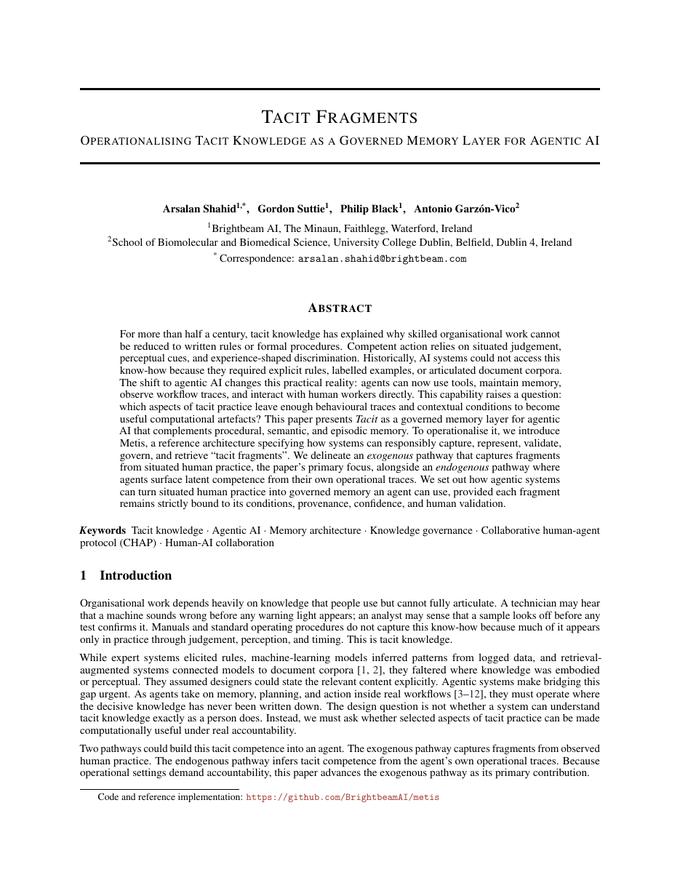
Tacit Fragments: Operationalising Tacit Knowledge as a Governed Memory Layer for Agentic AI
The preprint sets out the fragment model, capture methods and review process. It focuses on human expertise and also considers fragments drawn from an agent’s own activity, which need a higher standard of evidence. Its thirteen propositions guide further study.
We are exploring how to capture, structure and prepare expertise and judgement for AI. CHAP records collaboration and decisions. Metis provides a way to record, review and use fragments of expert practice. Evaluating the resulting behaviour helps us test whether an agent’s responses reflect the judgement a task requires, and which examples would be useful for training and testing.
06 / Questions
About the idea
One partial, situated account of practice. Its usefulness depends on preserving its source, conditions, uncertainty and validation. The practitioner's full expertise remains richer than the record.
A whisper is a short question used to check an observation with the practitioner. Deeper explanation uses structured elicitation: a Knowledge Audit and the Critical Decision Method map the practice, and a focused mini-CDM follows up when short questions show the work has changed or an account needs clarification.
No. The reference retrieval gate checks recorded conditions and permissions. A fragment is returned only when its required conditions and authority checks pass, and recorded consent has not been withdrawn. Your application can combine it with search and other memory.
About people
Practitioners should be able to agree to capture, inspect and challenge their records, and withdraw consent. Questions should ask about their practice without asking them to defend their performance. Withdrawal stops retrieval; a challenge opens a new review and does not itself suspend the record’s permission. Your application supplies the interfaces and access controls. The reference toolkit records no audio, video, biometrics, screenshots or keystrokes.
The practitioner confirms the account. A separate human review group decides its permitted use. Controlled instructions require formal change control. A model may assist with drafting; the decision belongs to people.
About building
CHAP is the Collaborative Human-Agent Protocol: it structures collaboration and provides an evidence record. Metis runs on CHAP and adds the fragment model, review lifecycle and retrieval conditions. The reference flow records capture, confirmation, review and retrieval as CHAP tasks.
Yes. The tacit layer complements procedural, semantic and episodic memory. Your application combines eligible guidance with the rest of the agent's context. Conditions and authority are checked before a tacit fragment may be used.
Metis is a reference toolkit. A real deployment adds authenticated identities, consent and reviewer workflows, domain validation, action controls and data governance. The research propositions remain a programme for evaluation, not evidence of production results.
Exploring the research
That is part of the research. A faithful description tells us what someone did; assessing its use also needs evidence about the circumstances and outcome, including cases where the same response would be unsuitable. An unsuccessful example may help people build an evaluation without becoming advice an agent is allowed to use. Whether to record it, and for what purpose, is a decision for the people involved.
Choose a workflow where experienced people make decisions the written procedure doesn’t fully explain. Consider one decision: what did the expert notice, why did it matter, and when would the same response be appropriate? That gives your team a concrete example to explore through Metis.
Metis · by Brightbeam
Bring a workflow where experience matters. With a practitioner and reviewer, we can examine a decision, identify what an agent would need to know, and agree how to assess the guidance.